
Packaging films, geomembranes, and flexible polymer materials are frequently exposed to impact forces during manufacturing, transportation, installation, and end-use service. A Falling Dart Impact Tester is one of the most widely used instruments for evaluating the ability of these materials to withstand sudden impact without failure. By quantifying impact resistance, manufacturers can optimize material formulations, improve product durability, and ensure compliance with industry standards.
Whether performing routine quality control on packaging films or conducting a dart impact test for geomembranes, impact resistance data provides valuable insight into material toughness and puncture resistance.
Why Impact Resistance Testing Matters
Flexible materials often experience accidental impacts that can lead to punctures, tears, or catastrophic failure. Traditional tensile testing evaluates strength under gradual loading, but many real-world failures occur under dynamic impact conditions.
Impact resistance testing helps manufacturers:
- Assess material toughness
- Compare different resin formulations
- Evaluate film thickness optimization
- Verify product consistency between production batches
- Support product development and material selection
- Meet customer and regulatory requirements
Industries including packaging, agriculture, construction, medical devices, and environmental engineering rely on impact testing data to validate product performance.
What Is a Falling Dart Impact Tester?
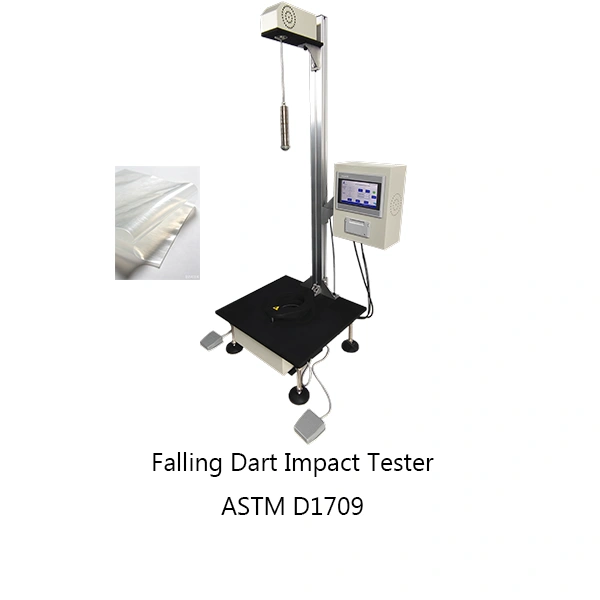
A Falling Dart Impact Tester is a laboratory instrument designed to determine the impact resistance of plastic films, sheets, and related flexible materials by dropping a weighted dart from a specified height onto a test specimen.
The test measures the energy required to cause failure and provides a statistical indication of the material’s resistance to impact.
The most commonly referenced standard for this evaluation is ASTM D1709, which specifies procedures for determining the impact resistance of plastic film by the free-falling dart method.
Basic Testing Principle
The testing principle is straightforward:
- A specimen is securely clamped.
- A dart with a specified geometry is raised to a defined height.
- The dart is released and falls freely onto the specimen.
- The operator records whether the specimen passes or fails.
- Multiple tests are conducted using varying dart masses.
- Statistical calculations determine the impact failure threshold.
The resulting value represents the mass or impact energy associated with a 50% probability of specimen failure.
Understanding ASTM D1709
Overview of ASTM D1709
ASTM D1709 is the most widely used standard for evaluating the impact resistance of plastic films using a falling dart method.
The standard includes two primary procedures:
| Method | Dart Type | Typical Application |
|---|---|---|
| Method A | Smaller dart with lower drop height | Thin films and lightweight packaging materials |
| Method B | Larger dart with higher drop height | Stronger films and higher-impact applications |
Both methods employ statistical testing techniques to determine the dart mass causing failure in approximately 50% of test specimens.
Key Test Parameters
Important variables include:
- Dart weight
- Drop height
- Dart geometry
- Specimen dimensions
- Failure criteria
- Number of test repetitions
- Environmental conditioning
Careful control of these variables ensures reliable and repeatable results.
Dart Impact Test for Geomembranes
While ASTM D1709 is commonly associated with packaging films, similar impact testing concepts are frequently applied in the evaluation of geomembranes.
A dart impact test for geomembranes helps determine resistance to puncture and impact damage that may occur during:
- Transportation
- Handling
- Site installation
- Backfilling operations
- Long-term service conditions
Geomembranes used in landfills, mining operations, reservoirs, and environmental containment systems must withstand mechanical stresses that could compromise containment performance.
Typical Geomembrane Materials
Impact testing is often performed on:
- HDPE geomembranes
- LLDPE geomembranes
- PVC geomembranes
- EPDM membranes
- Polypropylene geomembranes
- Composite liner systems
The test results help engineers compare material grades and select appropriate membrane thicknesses for demanding applications.
Test Procedure Using a Drop Dart Impact Tester
A modern drop dart impact tester automates many aspects of the testing process while maintaining compliance with applicable standards.
Specimen Preparation
Proper specimen preparation is critical for obtaining reliable data.
Recommended practices include:
- Sampling representative material
- Avoiding damaged areas
- Conditioning specimens before testing
- Maintaining consistent specimen dimensions
Testing Steps
A typical workflow includes:
- Mount specimen in the clamping fixture.
- Select appropriate dart configuration.
- Adjust dart mass according to expected material performance.
- Release the dart from the prescribed height.
- Inspect specimen for failure.
- Record pass/fail result.
- Repeat testing according to the statistical procedure.
- Calculate the 50% failure mass.
Modern systems often provide digital result calculation and data storage for enhanced traceability.
Interpreting Test Results
The primary output of a Falling Dart Impact Tester is the impact mass or energy corresponding to a defined probability of failure.
Higher Values Generally Indicate
- Greater toughness
- Better puncture resistance
- Improved handling durability
- Enhanced protection during transportation
Lower Values May Indicate
- Material brittleness
- Processing inconsistencies
- Excessive filler loading
- Reduced film integrity
However, impact resistance should always be evaluated alongside other mechanical properties such as tensile strength, elongation, tear resistance, and puncture resistance.
Applications Across Industries
Packaging Industry
Packaging manufacturers use impact resistance testing to evaluate:
- Stretch films
- Shrink films
- Food packaging films
- Agricultural films
- Industrial packaging materials
The goal is to prevent damage during shipping and handling.
Medical Packaging
Medical device and pharmaceutical packaging often requires impact-resistant materials to maintain sterile barrier integrity.
Testing helps verify package performance under transportation stresses.
Construction and Environmental Engineering
Geomembrane manufacturers perform dart impact test for geomembranes to assess durability for:
- Landfill liners
- Mining containment systems
- Water reservoirs
- Secondary containment structures
Research and Development
Material scientists use dart impact data to:
- Compare resin formulations
- Evaluate additives
- Optimize multilayer film structures
- Develop new products
Comparison of Common Impact Testing Methods
| Test Method | Primary Purpose | Typical Materials |
|---|---|---|
| ASTM D1709 Falling Dart | Dynamic puncture resistance | Plastic films |
| Pendulum Impact Test | Impact energy absorption | Rigid plastics |
| Izod Impact Test | Notched impact strength | Plastic specimens |
| Charpy Impact Test | Fracture behavior | Plastics and composites |
| Puncture Resistance Test | Penetration resistance | Films and membranes |
Each method evaluates different aspects of material performance, making test selection application-dependent.
Selecting the Right Falling Dart Impact Tester
When choosing a Falling Dart Impact Tester, laboratories should consider:
- Compliance with ASTM D1709
- Support for Method A and Method B
- Automated dart release mechanisms
- Digital result calculation
- Data management capabilities
- Repeatability and accuracy
- Fixture adaptability for various materials
For laboratories testing both packaging films and geomembranes, flexible configuration options can improve testing efficiency and expand application coverage.
Cell Instruments Solution for Falling Dart Impact Testing
Cell Instruments provides professional Falling Dart Impact Tester systems designed for ASTM D1709 compliance and routine impact resistance testing of flexible materials. These systems support quality control, product development, and laboratory research applications across packaging, medical, pharmaceutical, construction, and environmental industries.
In addition to standard instruments, Cell Instruments can provide customized fixtures, automated testing integration, and application-specific solutions for challenging materials, including multilayer films and geomembranes. The objective is to help laboratories obtain accurate, repeatable impact resistance data that supports product quality and performance verification.
Conclusion
A Falling Dart Impact Tester is an essential tool for evaluating the impact resistance of plastic films, flexible packaging materials, and geomembranes. Through standardized procedures such as ASTM D1709, manufacturers can quantify material toughness, compare product performance, and establish reliable quality control programs.
Whether performing routine packaging film evaluation or a specialized dart impact test for geomembranes, accurate impact resistance data enables informed engineering decisions, improved product reliability, and enhanced confidence in material performance under real-world conditions.