
Trouser Tear Test and Its Role in Material Performance Evaluation
The trouser tear test is a widely recognized mechanical test method used to evaluate how a material resists the growth of an existing tear under tensile loading. Unlike simple tensile strength measurements, this method focuses on tear propagation, which more closely reflects real-world failure conditions in plastic films, thin sheeting, and flexible packaging materials.
In packaging, medical, and industrial applications, a small defect can quickly expand into a catastrophic failure if the material lacks sufficient tear resistance. For this reason, the trouser tear test has become an essential quality control and R&D tool for manufacturers seeking to balance durability, flexibility, and cost efficiency. At Cell Instruments, we support this testing need with high-precision tensile testing systems designed for repeatable and standards-compliant results.
Tear Propagation Resistance in Plastic Films
Tear propagation resistance describes a material’s ability to resist continued tearing once a crack or slit has already formed. This property is particularly important for flexible materials, where stretching, folding, or impact during transportation can initiate tears.
Plastic films with insufficient tear propagation resistance may perform well in tensile tests but still fail during use. This explains why the tear test of plastic film is often specified alongside tensile and puncture tests in packaging standards. By measuring the force required to continue a tear, manufacturers gain insight into how materials behave after initial damage.
For products such as food packaging, pharmaceutical pouches, and industrial liners, controlling the tear strength of plastic film helps reduce leakage, contamination risks, and product loss.
Why Tear Strength of Plastic Film Matters in Packaging
In flexible packaging, the tear strength of plastic film directly influences usability and safety. Films that tear too easily may rupture during filling or transport, while films with excessive tear resistance may frustrate end users during opening.
The trouser tear test helps manufacturers:
- Optimize material formulations for balanced performance
- Compare machine direction and transverse direction properties
- Detect inconsistencies between production batches
- Validate compliance with customer or regulatory requirements
This makes the puncture resistance test complementary but not interchangeable, as puncture focuses on localized penetration, while the trouser tear test evaluates controlled crack growth.
Test Setup and Equipment Considerations
Accurate trouser tear testing requires a constant-rate-of-grip separation tensile tester with precise force measurement and stable grip alignment. Grip slippage or misalignment can significantly affect results, especially for thin or highly extensible films.
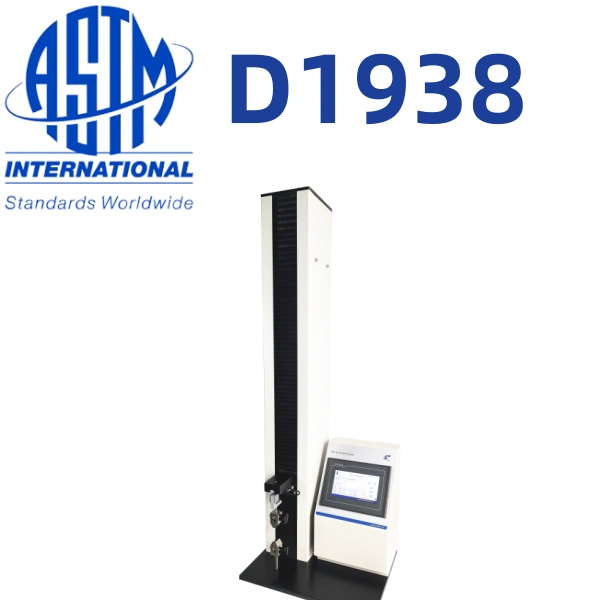
Cell Instruments tensile testers are well suited for ASTM D1938 applications due to:
- High-resolution load cells for low-force tear measurements
- Stable crosshead speed control to meet standard requirements
- Flexible grip options for thin films and laminated structures
- Reliable data acquisition for tear force analysis
These features allow quality control and R&D teams to obtain consistent and repeatable trouser tear data across multiple materials.
Applications Beyond Plastic Film
Although ASTM D1938 focuses on plastic film and thin sheeting, the trouser tear test concept is also relevant to coated fabrics, laminates, and certain textile structures. In medical and pharmaceutical packaging, understanding tear propagation behavior supports better sterile barrier design. In industrial and agricultural films, it helps predict performance under stress and environmental exposure.
By integrating trouser tear testing into a broader mechanical testing program, manufacturers can make data-driven decisions that improve product reliability and customer satisfaction.
Conclusion and Practical Value for Manufacturers
The trouser tear test provides essential insight into how materials behave once a tear has started—information that tensile strength alone cannot deliver. Through standardized methods such as ASTM D1938, manufacturers can reliably evaluate tear propagation resistance and compare materials with confidence.
With advanced tensile testing solutions from Cell Instruments, laboratories can conduct tear tests efficiently while maintaining accuracy and compliance. This approach supports continuous improvement in material design, packaging safety, and overall product quality across diverse industries.