
Geomembranes Tearing Strength and Why ASTM D5884 Matters
When geomembranes encounter installation stress, sharp edges, or differential settlement, localized damage can occur. Geomembranes tearing strength directly affects service life and safety. ASTM D5884 plays a key role in quantifying this behavior by ensuring that tear resistance is measured in a standardized environment.
The method provides insight into:
- Differences in reinforcement fabric type
- Performance variation between directions (MD and CMD)
- Maximum resistance force prior to tear propagation
- Comparative durability among geomembrane products
Such data helps project teams control risk in applications such as landfills, wastewater treatment, mining pads, and secondary containment.
Tongue Tearing Test Procedure Explained
The tongue tearing test outlined in ASTM D5884 uses a pre-cut specimen that creates two “tongues,” which are pulled in opposite directions. This configuration concentrates the stress at the cut tip and promotes tear propagation.
Key steps include:
- Centering the specimen so that each tongue aligns with the clamping jaws.
- Maintaining a grip separation of 75 mm to create a consistent load path.
- Running the test at 50 ± 2 mm/min to maintain comparable strain rates.
- Recording the force needed to extend the tear 75–100 mm through the membrane.
If a specimen tears off-axis or produces abnormal values, it must be discarded and replaced.
The peak load observed during tongue separation represents the material’s tear tensile strength.
This method allows laboratories to determine an average tearing strength based on multiple samples, typically five in each primary direction, improving statistical confidence.
Measuring Tear Tensile Strength for Reinforced Geomembranes
Tear tensile strength in ASTM D5884 refers to the highest force recorded during the tearing event. This value reflects how effectively the reinforcement fabric and polymer matrix work together to resist tearing under controlled stress.
Accurate measurement depends heavily on:
- Stable crosshead speed
- Precise displacement accuracy
- Reliable load measurement within the expected range
- Properly designed gripping mechanisms to avoid slippage or premature failure
Because internally reinforced geomembranes can show very different behavior depending on textile structure, using a capable testing system is essential for obtaining trustworthy data.
Recommended Equipment for ASTM D5884 Testing
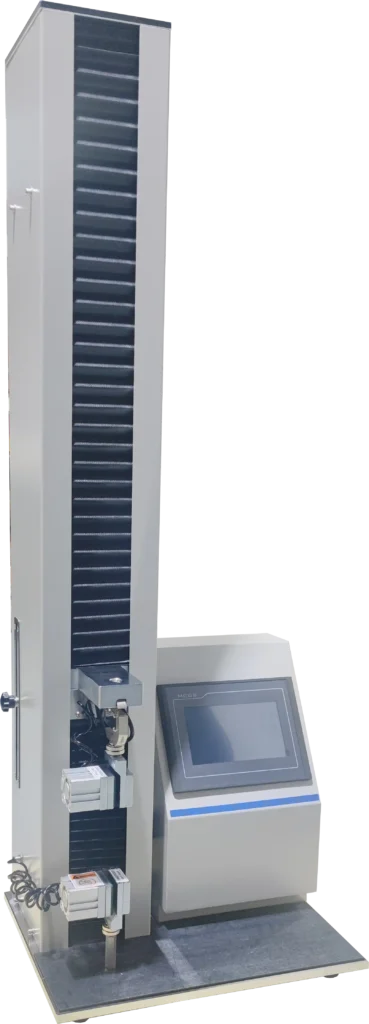
For laboratories or manufacturers performing ASTM D5884, a high-precision tensile testing machine ensures consistent and defensible results.
Cell Instruments offers the TST-01 Tensile Tester, which is well-suited for ASTM D5884 due to its:
- Wide force range (0–500 N standard, optional up to 1 kN) supporting most geomembrane tear tests
- Adjustable speed from 1–500 mm/min, allowing accurate control of the 50 mm/min test rate
- Precision displacement accuracy of ±0.01 mm, minimizing variability
- Multi-fixture compatibility, enabling secure gripping of reinforced geomembranes
- Stable PLC-driven control and real-time curve display, helping operators monitor peak tearing loads clearly
In addition to ASTM D5884 tear testing, the instrument can also support tensile, puncture, peel, seal strength, and adhesion testing, making it an ideal tool for laboratories handling composite or multilayer materials.
By integrating such equipment, users improve test repeatability, reduce operator influence, and produce results that meet both internal QC requirements and international compliance demands.
Applications of ASTM D5884 for Industry Professionals
Professionals involved in geomembrane production, installation, or quality verification rely on this standard to:
- Compare performance between different reinforcement systems
- Evaluate material suitability for high-stress environments
- Support product development by studying how fabric structure influences tear behavior
- Verify batch consistency and ensure every roll meets performance expectations
- Build documentation for project certification and regulatory requirements
With reliable testing aligned to ASTM D5884, manufacturers strengthen product competitiveness, while laboratories and engineering firms gain confidence that geomembrane systems will perform under real-world mechanical demands.