
Paper & Fabric & Plastic Testing Standards
The Elmendorf tearing test supports a broad range of materials and applications, and its relevance is reflected in the number of standards that reference this method.
For paper tear strength, standards such as ASTM D1424, ISO 1974, and TAPPI T414 define procedures for measuring the force required to propagate a tear in paper and paperboard. These standards remain essential for packaging, printing, and specialty paper manufacturers.
In fabric tearing strength testing, ISO 13937-3 and ISO 6383-2 describe Elmendorf-based approaches for woven and nonwoven textiles. These methods help assess durability in garments, technical textiles, and industrial fabrics.
For tear strength of plastic film, ASTM D1922 and ASTM D689 apply the Elmendorf tearing test principle to flexible plastic materials, including polyethylene, polypropylene, and multilayer films. ASTM D751 further extends tearing evaluation to coated fabrics and industrial laminates.
Together, these standards demonstrate how the Elmendorf tearing test adapts to different material structures while maintaining a consistent testing philosophy.
Test Principle and Equipment Overview
At the heart of the Elmendorf tearing test lies a pendulum impact system. The specimen, pre-cut with a small slit, mounts securely in the clamps. When the pendulum releases, it propagates the tear across the sample width in a single motion.
Key elements of the test setup include:
- A calibrated pendulum with selectable energy ranges
- Precision specimen clamps to prevent slippage
- Standardized specimen dimensions based on the applicable standard
- A clear scale or digital system for reading tearing force or energy
Modern instruments such as the Cell Instruments Tear Tester SLD-01 combine mechanical reliability with digital measurement, improving repeatability while supporting multiple international standards.
Test Principle and Equipment Overview
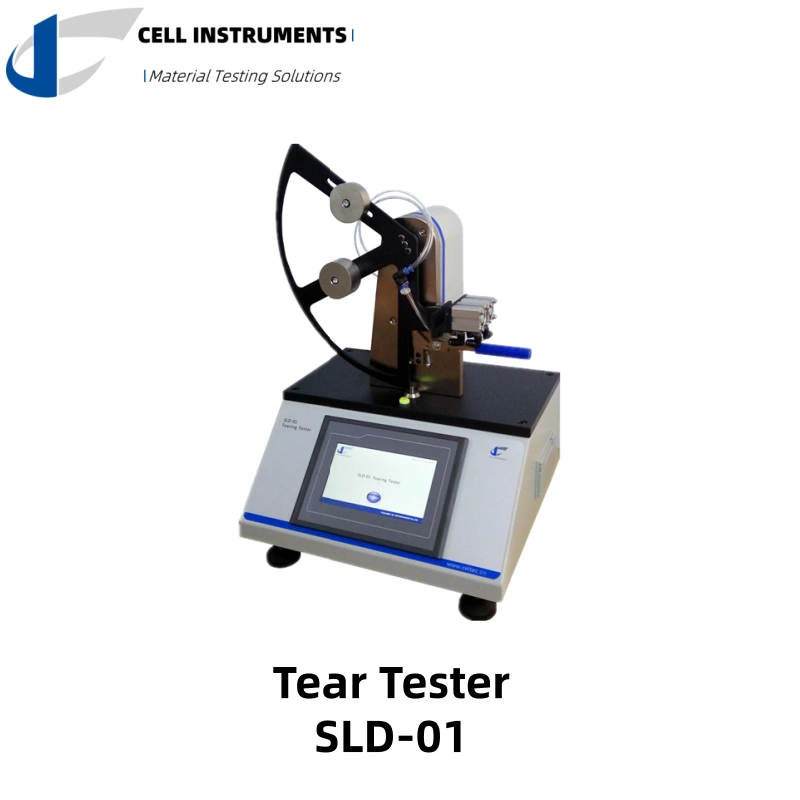
At the heart of the Elmendorf tearing test lies a pendulum impact system. The specimen, pre-cut with a small slit, mounts securely in the clamps. When the pendulum releases, it propagates the tear across the sample width in a single motion.
Key elements of the test setup include:
- A calibrated pendulum with selectable energy ranges
- Precision specimen clamps to prevent slippage
- Standardized specimen dimensions based on the applicable standard
- A clear scale or digital system for reading tearing force or energy
Modern instruments such as the Cell Instruments Tear Tester SLD-01 combine mechanical reliability with digital measurement, improving repeatability while supporting multiple international
Typical Test Procedure
Although details vary slightly among ASTM, ISO, and TAPPI standards, the general Elmendorf tearing test procedure follows a consistent structure:
- Prepare specimens according to the selected standard, ensuring accurate dimensions and pre-cuts.
- Condition samples under controlled temperature and humidity to reduce environmental influence.
- Mount the specimen carefully, aligning it to ensure a straight tear path.
- Release the pendulum to propagate the tear in one continuous action.
- Record the tearing force or energy and calculate average values from multiple specimens.
This straightforward process allows laboratories to perform routine testing efficiently without sacrificing accuracy.